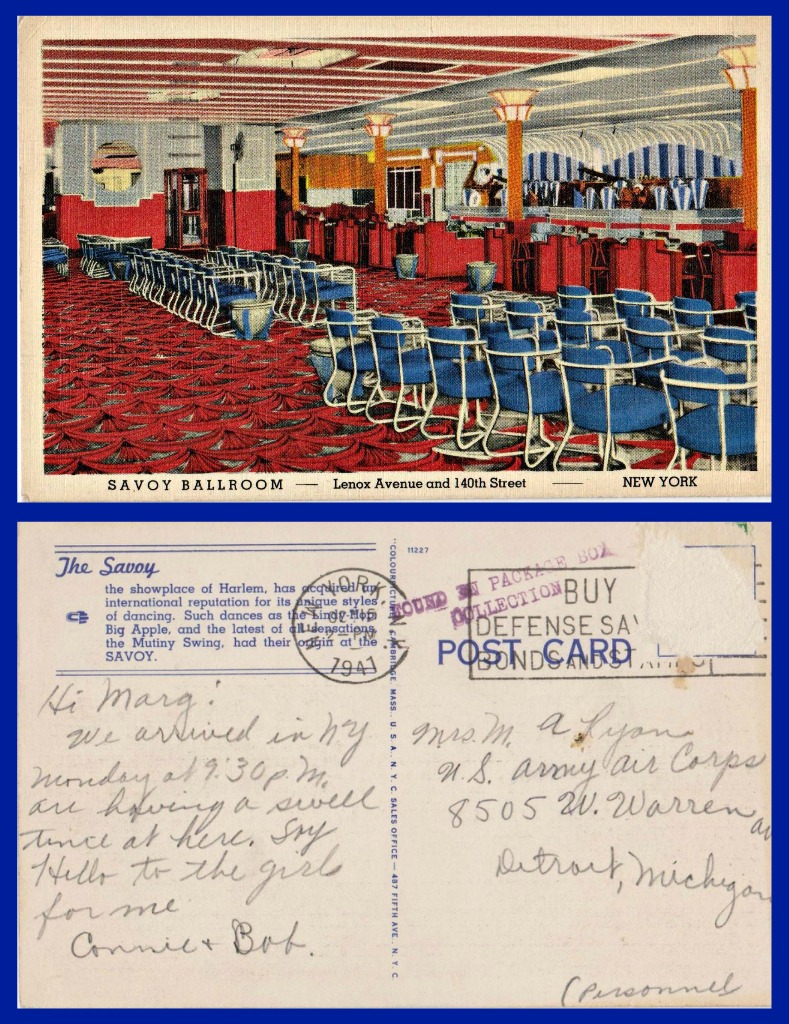
Postcard story from New York: “STOMPING AT THE SAVOY IN HARLEM”
New York, October 15, 2:00pm, 1954
The Savoy the showplace of Harlem, has acquired an international reputation for its unique styles of dancing. Such dances as the Lindy-Hop, Big Apple, and the latest of all sensations the Mutiny Swing, had their origin at The Savoy.
To: Mrs. M. A. Ryan
U.S. Army Air Corps
8505 W. Warren Ave
Detroit, Michigan
Personnel
“Hi Marg: We arrived in NY Monday at 9:30p.m. are having a swell time here. Say hello to the girls for me
Connie + Bob”
Sadly Connie & Bob’s adventures at the famed Savoy were never received by Mrs. M. A Ryan at the U.S. Army Air Corps since the postcard is stamped “FOUND IN PACKAGE BOX COLLECTION”.
It is guaranteed that Connie & Bob had a ‘swell time’ since The Savoy nightclub was dubbed the swingingest hot spot in Harlem and all of New York City. The first non segregated club allowing blacks and whites to swing together. The famed Cotton Club was for white patrons only with famed black musicians on stage. At The Savoy – real hep cats dug some cool jive on the be-bop side! They were jammed packed every night from March 12, 1926 to July 10, 1958. Often thousands had to be turned away. The Savoy is deeply rooted in our dance, music and culture. Music united all at the Savoy !
Read about it’s wonderful history here and see the link to the YouTube videos below.
http://en.wikipedia.org/wiki/Savoy_Ballroom
See a brief video history:
https://www.youtube.com/watch?v=Mqsc0dhoED0
https://www.youtube.com/watch?v=UmnsWcxdhEQ
With swing’s rise to popularity and Harlem becoming a connected Black community, The Savoy opened at a perfect time, giving the rising talented and passionate Black dancers an equally beautiful venue. The Savoy’s ballroom, which was 10,000 square feet in size, was on the second floor and a block long. It could hold up to 4,000 people. The interior was painted pink and the walls were mirrored. Colored lights danced on the sprung layered wood floor. In 1926, the Savoy contained a spacious lobby framing a huge, cut-glass chandelier and marble staircase.
The Savoy was extremely popular right from the start. A headline from the New York Age March 20, 1926 reads “Savoy Turns 2,000 Away On Opening Night – Crowds Pack Ball Room All Week”. The ballroom didn’t go dark a single night of the week.
The Savoy even participated in the 1939 New York World’s Fair, presenting “The Evolution of Negro Dance”.
The Savoy was unique in having the constant presence of a skilled elite of the best Lindy Hoppers, known as “Savoy Lindy Hoppers”. Occasionally, groups of dancers such Whitey’s Lindy Hoppers turned professional and performed in Broadway and Hollywood productions. Whitey turned out to be quite a successful agent, and in 1937, the Marx Brothers’ movie A Day at the Races featured the group. Herbert White was a bouncer at the Savoy who was made floor manager in the early 30s. He was sometimes known as Mac, but with his ambition to scout dancers at the ballroom to form his own group, he became widely known as Whitey for the white streak of hair down the center of his head. He looked for dancers who were “. . . young, stylized, and, most of all, they had to have a beat, they had to swing”. The Savoy held a yearly dancing festival called the Harvest Moon Ball featuring lindy dancers. The first Ball was held in 1935, and the contestants introduced the Lindy Hop to Europe the next year.
Unlike many ballrooms such as the Cotton Club, the Savoy always had a no-discrimination policy. Generally, the clientele was 85% black and 15% white, although sometimes there was an even 50/50 split. Lindy hop legend Frankie Manning noted that patrons were only judged on their dancing skills and not on the color of their skin: “One night somebody came over and said, ‘Hey man, Clark Gable just walked in the house.’ Somebody else said, ‘Oh, yeah, can he dance?’ All they wanted to know when you came into the Savoy was, do you dance?”. Virtuosic dancers, however, excluded others from the northeast corner of the dance floor, now referred to as the “Cat’s Corner,” although the term was not used at the time. This part of the floor where the professional Lindy dancers ruled was on the 141st street side of the room and was then referred to just as “the corner”. Only Whitey’s Lindy Hoppers could dance and work routines there. Competition was huge in “the corner” and every serious hopper awaited the nightly “showtime”. Other dancers would create a horseshoe around the band and “ . . . only the greatest Lindy-hoppers would stay on the floor, to try to eliminate each other”. On 140th street was the opposite, mellow corner which was popular with dancing couples. The skilled Tango dancer known as The Sheik frequented this corner.
Many dances such as Lindy Hop (which was named after Charles Lindbergh and originated in 1927) were developed and became famous there. It was known downtown as the “Home of Happy Feet” but uptown, in Harlem, as “the Track” because the floor was long and thin. The Savoy earned the nickname “Home of Happy Feet” from Lana Turner who remarked of the dancers, “What happy feet these people have”. The Lindy Hop is also known as The Jitterbug and was born out of “. . . mounting exhilaration and the ‘hot’ interaction of music and dance”. Other dances that were conceived at the Savoy are The Flying Charleston, Jive, Snakehips, Rhumboogie, and variations of the Shimmy, Mambo, and many more.
It is estimated that the ballroom generated $250,000 in annual profit in its peak years from the late 20s to the 40s. Each year, the ballroom was visited by near 700,000 people. The normal entrance fee was 30 to 85 cents per person, depending on what time a person came. 30 cents was the base price, but after 6pm the fee was 60cents, and then 85cents after 8pm. The Savoy had made enough money by its peak of business in 1936 that $50,000 was spent on remodeling it.[
The ballroom had a double bandstand that held one large and one medium sized band running against its east wall. Music was continuous as the alternative band was always in position and ready to pick up the beat when the previous one had completed its set. The bouncers, who had previously worked as boxers, basketball players, and the like, wore tuxedos and made $100/night. The floor was watched inconspicuously by a security force of four men at a time who were headed by Jack La Rue, and no man was allowed in who wasn’t dressed in a jacket with a tie. Besides the security staff, the Savoy was populated by “Harlem’s most beautiful women”: the Savoy Hostesses. They would be fired for consorting with patrons outside the ballroom, but inside the hostesses would teach people to dance and were dance partners for anyone who purchased a 25 cent dance ticket. Roseland Ballroom hostesses often visited the savoy on their night off; this inspired Buchanon to create Monday-Ladies-Free Nights. Other special events began during the week, including the giveaway of a new car every Saturday. The floor had to be replaced every 3 years due to its constant use.
“Stompin’ at the Savoy“, a 1934 Big Band classic song and jazz standard recorded by Chick Webb, was named after the ballroom. The song was featured in an episode of I Love Lucy in which she performs the Jitterbug.
Chick Webb was the leader of the best known Savoy house band during the mid-1930s. A teenage Ella Fitzgerald, fresh from a talent show win at the Apollo Theater in 1934, became its vocalist. Floating World Pictures recently made a documentary called “The Savoy King” about Webb, Ella, and the ballroom. It was shown at the 50th New York Film Festival.
The Savoy was the site of many famous “Battles of the Bands” or “Cutting Contests“, which started when the Benny Goodman Orchestra challenged Chick Webb in 1937. Webb and his band were declared the winners of that contest. In 1938, Webb was once again challenged by Count Basie Band. While Webb was officially declared the winner again, there was a lack of consensus on who actually won that night. Earle Warren, the alto saxophonist for Basie reports that they had worked on a song called “Swingin’ the Blues” for the purpose of competing and says, “When we unloaded our cannons, that was the end”. Webb’s “unbeatable” band had been bested.
The Savoy participated in the 1939 New York World’s Fair, presenting “The Evolution of Negro Dance”.
Despite efforts by Borough President Hulan Jack and others to save it, the Savoy and the nearby Cotton Club were demolished for the construction of a housing complex, Bethune Towers/Delano Village. The Ballroom was shut down as a result of “charges of vice filed by the police department and Army”. The mayor was the target of protest by angered members of The National Association for the Advancement of Colored People. The ballroom was auctioned off for $25,000 to a “middle-income housing project”. Count Basie was quoted in the paper saying “With the passing of the Savoy Ballroom, a part of show business is gone. I feel about the same way I did when someone told me the news that Bill (Bojangles) Robinson was dead”. On 26 May 2002, Frankie Manning and Norma Miller, surviving members of Whitey’s Lindy Hoppers, unveiled a commemorative plaque for the Savoy Ballroom on Lenox Avenue between 140th and 141st Streets. The tradition of swing has lived on today and many surviving dancers from the Savoy still dance when they can. As Norma Miller says in her memoir, “Although Harlem created it, the Lindy belongs to everyone”.



 NEW YORK CITY - IN THE WIT OF AN EYE